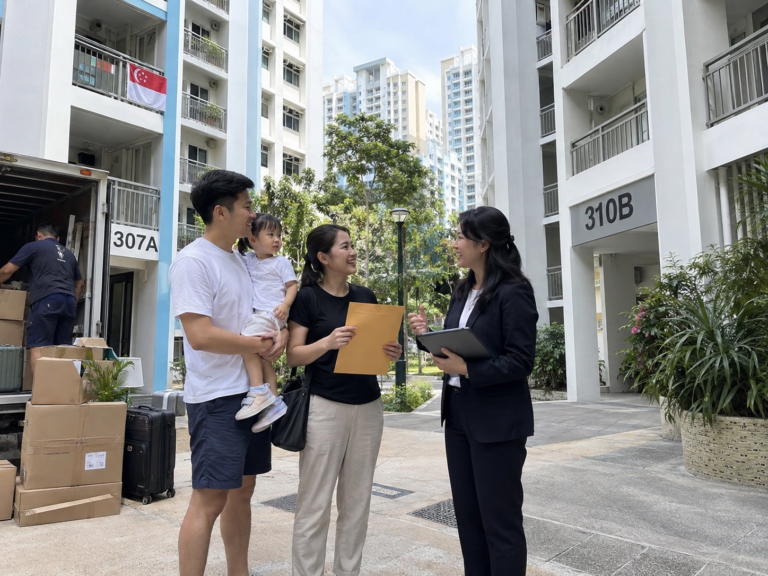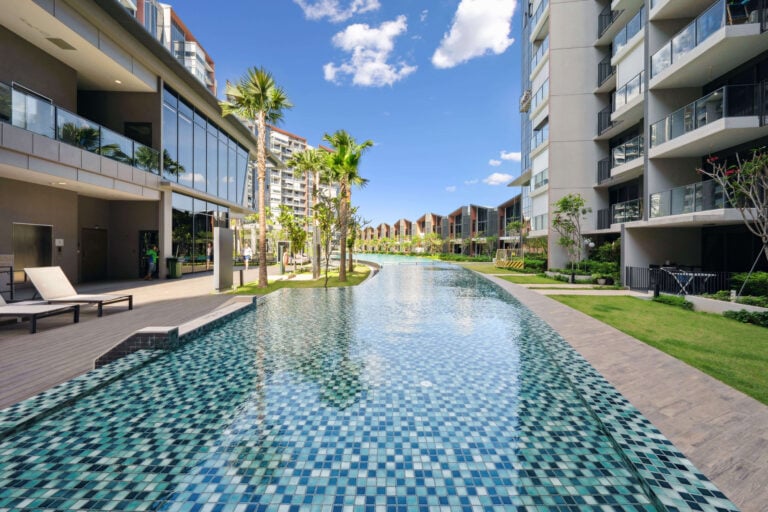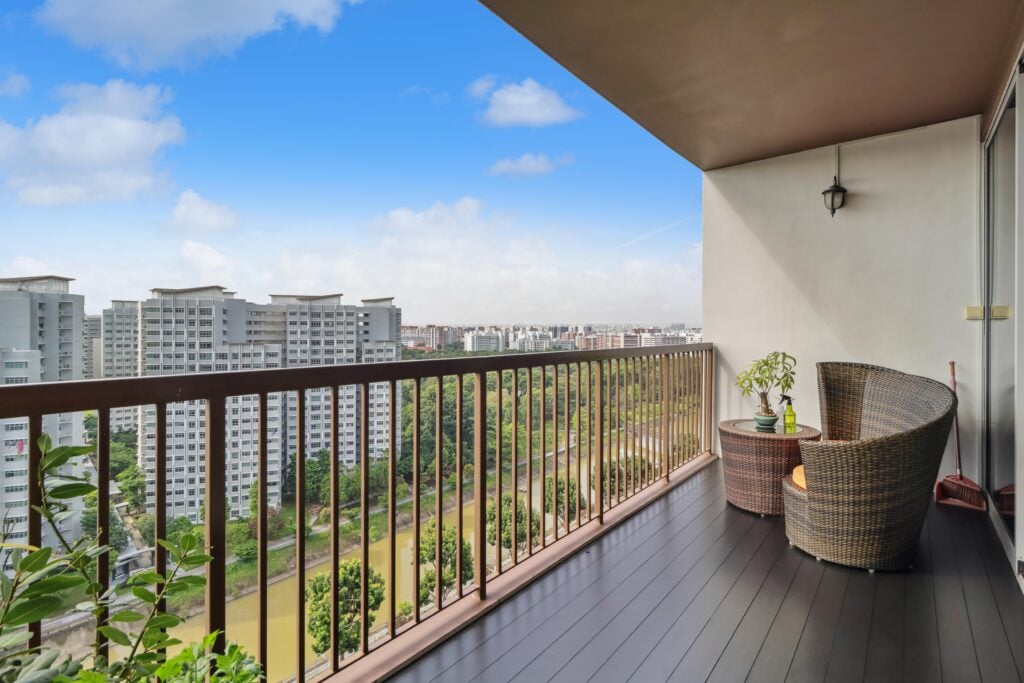
Buying a home in Singapore often comes down to one big question: should you get an HDB flat or stretch your budget for a private condo?
At first glance, the differences seem obvious.
HDB flats are generally more affordable, while condos come with private facilities and fewer ownership restrictions.
But once you factor in eligibility rules, grants, financing, stamp duties, ongoing costs, and your future plans, the decision becomes a lot less straightforward.
This guide walks through the key differences between HDB flats and private condos, so you can figure out which option makes more sense for your situation.
You can also check out our other comparison guides on BTOs vs resale flats and executive condos vs private condos, if they’re more relevant to you.
1. Eligibility criteria
Before comparing prices or facilities, first check whether you can actually buy the property you have in mind.
HDB flats come with considerably more eligibility requirements, particularly around citizenship, age, income, and existing property ownership.
Private condos are much more straightforward in this respect, although taxes such as Additional Buyer’s Stamp Duty may still apply depending on your residency status and how many properties you own.
Here’s how the two compare:
| Eligibility factor | HDBs | Condos |
| Citizenship | One person must be a Singapore Citizen (SC), and the application must include at least 1 other SC or Singapore Permanent Resident (SPR). For SPR households without an SC applicant, everyone must have held SPR status for at least 3 years. Check the full criteria on HDB’s website. | Open to SCs, SPRs, foreigners, and companies. |
| Foreigners | Foreigners cannot buy an HDB flat, whether new or resale. | Foreigners can buy private residential property, but are generally subject to 60% Additional Buyer’s Stamp Duty (ABSD). |
| Singles | Generally eligible from age 35, but only for a 2-room Flexi BTO or resale flat. | Eligible to buy from age 21. |
| Income ceiling | 2-room Flexi BTO: $7,000. 3-, 4- or 5-room BTO: $14,000, or $21,000 when applying with an extended or multi-generation family. Resale flats have no income ceiling, although income affects grant eligibility. | No income ceiling. |
| Property ownership | You must not own another property locally or overseas at the point of application. | No equivalent restriction, although ABSD may apply to your second and subsequent properties. |
For many buyers, this section alone narrows down the options considerably.
If you do not meet HDB’s eligibility requirements, a private property may be your main option.
2. Price and affordability
For most households, price is where the gap between HDB flats and condos becomes most noticeable.
HDB flats generally offer a much lower entry point into homeownership.
That said, HDB prices can still vary substantially depending on whether you’re buying a new or resale flat, the location, and whether the project falls under the Standard, Plus, or Prime classification.
If you’re considering purchasing a new BTO flat, you can take reference from the latest June 2026 BTO exercise – 3-room flats start from $250,000 for Standard flats, $380,000 for Plus flats, and $435,000 for Prime flats.
As for resale flats, you can have a look at the latest median prices for each quarter here, depending on the estate it is located in. Ranging from $400,000+ for a 3-room flat to $600,000+ for a 5-room flat, it still sits well below the prices of private condos.
Condos require a much bigger budget.
New launches average around S$2,200 per square foot (psf), with prices climbing considerably higher in prime locations.
Even a compact 2-bedroom condo can cost well above S$1.5 million in many parts of Singapore.
Resale condos may offer a cheaper entry point than brand-new developments, but you’ll still generally pay a sizeable premium compared with an HDB flat of a similar size.
3. Grants and subsidies
This is one area where HDB flats have a major advantage.
There are no government housing grants for someone purchasing a private condo, even if it is their first property.
HDB buyers, on the other hand, may qualify for several grants depending on their income, household profile, and whether they’re buying a new or resale flat.
The main one is the Enhanced CPF Housing Grant (EHG), which can apply to both new and resale HDB purchases.
Resale buyers may also be able to combine the EHG with the Family Grant and Proximity Housing Grant (PHG).
Additional grants like the Step-Up CPF Housing Grant are also available if you and your family are second-timer applicants.
The maximum amount a household can receive across all grants is capped at $230,000.
| Grant | BTO | Resale | Income Ceiling | Grant Amount |
| Enhanced CPF Housing Grant (EHG) | ✔ | ✔ | $9,000/month | Families: $120,000
Singles: $60,000 |
| Proximity Housing Grant (PHG) | — | ✔ | None | Families: $20,000 – $30,000;
Singles: $10,000 – $15,000 |
| Family Grant (FG) | — | ✔ | $14,000/month | 2- to 4-room: $70,000–$80,000;
5-room and larger: $40,000–$50,000 |
| Step-Up Housing Grant | ✔ | ✔ | $7,000/month | $15,000 |
The difference can be significant.
For eligible buyers, grants can bring down the effective cost of an HDB flat substantially before you’ve even considered the lower purchase price.
4. Loans and downpayment
HDB buyers also get more flexibility when it comes to financing.
If you’re buying an HDB flat, you may be able to choose between an HDB housing loan and an HDB bank loan.
Your CPF Ordinary Account (OA) savings can also be used towards the purchase, together with cash.
Private condo buyers do not have the HDB loan option and will generally need to take a bank loan if financing is required.
| HDB Loan | Bank Loan | |
| Interest rates | Currently at 2.6% p.a. (0.1% above the prevailing CPF OA interest rate). | There are two options for you to choose from:
|
| Lock-in period | No lock-in period | Typically includes a lock-in period |
| Loan-to-value (LTV) limit | Up to 75% of the purchase price or market value (whichever is lower). | Up to 75% of the purchase price or valuation (whichever is lower). |
| Downpayment | 25%. Can be paid using your CPF OA savings, cash, or a mix of both. No mandatory cash requirement. | 25%. Requires a strict minimum 5% in cash, while the remaining 20% can be paid via cash or CPF OA. |
| Maximum loan tenure | 25 years | Up to 30 years, extending to 35 years for private properties |
| Type of property | New flats, resale flats | New flats, resale flats, Executive Condominiums (ECs), private property |
| Servicing ratio | Subject to the Mortgage Servicing Ratio (MSR), capping your housing loan repayments at 30% of your gross monthly income. | Subject to the Total Debt Servicing Ratio (TDSR) of 55% — which covers all your debt obligations, not just housing. |
The cash requirement is worth paying attention to if you’re considering a condo.
A 5% mandatory cash downpayment might not sound huge as a percentage, but on a S$1.5 million property, that’s S$75,000 in cash before considering your other upfront costs.
5. Stamp duty
Whether you buy an HDB flat or private condo, you’ll have to pay Buyer’s Stamp Duty (BSD).
BSD is calculated based on the purchase price or market value of the property, whichever is higher.
Where things start to differ is Additional Buyer’s Stamp Duty.
If you’re a Singapore Citizen buying your first residential property, you generally won’t have to pay Additional Buyer’s Stamp Duty (ABSD).
ABSD kicks in when you purchase additional properties.
For Permanent Residents and foreigners, however, ABSD can apply from the first residential property purchase.
The current rates are:
- Singapore Citizens: 0% for the first home, 20% for the second home, and 30% for the third and subsequent homes.
- Singapore PRs: 5% for the first home, 30% for the second home, and 35% for the third and subsequent homes.
- Foreigners: 60% for any residential property.
This becomes particularly important if you’re thinking of keeping your existing home while purchasing another.
At higher property prices, ABSD can easily become one of the largest upfront costs in the entire transaction.
For the full breakdown, read our complete guide to stamp duty in Singapore.
6. Minimum Occupation Period
Flexibility is another major difference between HDB flats and private condos.
HDB homeowners need to comply with a Minimum Occupation Period (MOP).
Standard flats generally come with a 5-year MOP, while newer Plus and Prime flats have a 10-year MOP.
During this period, you must physically occupy the flat.
You cannot simply sell the flat or rent out the entire unit whenever you want.
Private condos don’t have an MOP.
Once you’ve bought a private condo, you’re generally free to sell or rent it out without having to wait for an occupation period to end.
We’re referring specifically to private condos here, because executive condos are still subject to an MOP.
There’s also some good news if you currently own private property and are considering moving into a resale HDB flat.
The 15-month wait-out period has been removed, making it easier for homeowners to right-size when their circumstances change and potentially free up cash and CPF in the process.
7. Monthly cost of ownership
The day-to-day costs are significantly lower for an HDB flat.
You’ll be required to pay Service & Conservancy Charges (S&CC), which help to fund cleaning of the estate, maintenance of lifts, and general upkeep of all common areas. This usually costs about $20 to $100 a month.
In addition, the government previously announced S&CC rebates under the permanent GST Voucher Scheme and the Assurance Package, so if your household is eligible, you’ll get to enjoy further savings in the future too.
As for condos, you’ll be required to pay Management Corporation Strata Title (MCST) fees which range from $300 to $800 a month. These fund maintenance of the pool, gym, common areas, and other facilities.
Don’t forget about property tax too! As condos generally have a higher Annual Value (AV) than HDB flats in the same tax band, as an owner-occupier, you can expect to pay noticeably more in property tax if you own a condo.
8. Facilities and lifestyle
Money aside, think about how you’ll actually use your home.
HDB estates are built around communal living and usually come with amenities such as playgrounds, fitness corners, childcare centres, and void decks.
Many newer BTO developments have also added features such as rooftop gardens and sheltered or connected walkways between blocks.
Condos offer a different experience.
Depending on the development, facilities can include swimming pools, indoor gyms, barbecue pits, tennis courts, landscaped gardens, function rooms, and 24-hour security.
Higher-end developments may go further with private lifts, co-working areas, and dedicated fitness studios.
Of course, having access to a tennis court or pool only has value if you’re actually going to use it.
Otherwise, you may effectively be paying higher monthly maintenance fees for facilities that look great during the viewing but rarely become part of your everyday life.
9. Size and layout
If getting more space for your money is important, HDB flats are difficult to ignore.
Demand for older resale flats has remained high, partly because many buyers value the larger floor areas they can offer.
Older 4-room resale flats can measure around 100 to 104 square metres, compared with around 90 square metres for many newer flats.
Then there are maisonettes.
These discontinued two-storey HDB flats can range from around 133 to 243 square metres and remain popular among buyers who want a generous amount of living space without moving into landed property.
Although no new maisonettes have been built since 2000, existing units continue to attract buyers looking for something less conventional.
Condos offer a wider range of formats, from compact studios to large penthouses, but the price per square foot is typically much higher.
That means the same budget may buy you noticeably less internal space in a condo than in an HDB resale flat.
10. Location options
Location isn’t necessarily an HDB-versus-condo issue because both can be found across Singapore.
There are HDB flats across all 26 towns, giving buyers plenty of choices depending on where they work, where their family lives, and which neighbourhoods they prefer.
If you’re hoping to qualify for the Proximity Housing Grant when buying a resale flat, remember that your parents or children generally need to live within 4km of the flat you’re purchasing.
Private condos are spread throughout the island as well, although there tends to be a greater concentration of developments in prime and central districts.
Rather than focusing purely on the property type, look at what surrounds the development.
Access to MRT stations, food centres, supermarkets, schools, shopping malls and other everyday amenities can have a much bigger effect on your quality of life than having a particular postcode.
11. Renting your HDB or condo out
If rental income is part of your plan, the rules surrounding HDB flats and condos are quite different.
You can rent out an HDB flat after completing the MOP, provided you own a 3-room or larger flat and comply with HDB’s subletting conditions.
There are restrictions on matters such as the maximum number of tenants, and quotas may apply to non-citizen tenants at the neighbourhood and block level.
Owners of HDB flats under the Plus and Prime schemes face additional restrictions.
Renting out the entire flat is not allowed, which is intended to discourage these homes from being purchased primarily as investment properties.
Private condos are considerably more flexible.
There is no MOP, and owners can generally rent their units out without the same HDB tenant quotas.
If rental flexibility is an important part of your property strategy, a private condo therefore has a clear advantage.
12. Resale value and capital appreciation
The final comparison isn’t simply about what the property costs today.
You’ll also want to consider how easy it may be to sell in the future and what could affect its value over time.
HDB flats typically come with a 99-year lease.
Condos, meanwhile, can either be leasehold — including 99-year developments — or freehold.
For leasehold properties, the remaining lease matters.
As the lease gets shorter, it can affect the property’s resale value as well as how much CPF and financing future buyers may be able to use.
If you want to maximise CPF OA usage and maintain a more favourable loan-to-value limit, you may want to look at properties with at least 60 years remaining on the lease.
But tenure is only one piece of the puzzle.
The property’s location, floor level, orientation, layout, size, nearby amenities, market supply and government housing policies can all influence resale demand and price.
Freehold condos don’t face lease decay in the same way, but that doesn’t automatically make them a better investment than leasehold condos.
A freehold property can make sense if you’re thinking about holding an asset across generations.
Leasehold developments, however, can offer lower entry prices, potentially higher short-term rental yields, and newer facilities.
The better choice depends on what you’re actually trying to achieve.
Is buying a condo more expensive than an HDB flat?
In most cases, yes.
HDB buyers may benefit from government subsidies, CPF housing grants, and access to an HDB loan, while private condo buyers generally have to purchase at market price without those same advantages.
The difference doesn’t stop after you’ve collected your keys either.
Condo owners typically face much higher monthly maintenance charges, while the higher Annual Value of private properties can also mean a larger property tax bill.
So when comparing affordability, don’t look only at the property’s advertised price.
Consider the total upfront cash required, loan repayments, taxes, and ongoing ownership costs as well.
Should you choose an HDB or condo?
There isn’t one answer that works for everyone.
The better choice depends on your budget, eligibility, lifestyle, and what you intend to do with the property over the next several years.
If you’re buying your first home and affordability is your main concern, an HDB flat will usually give you a much lower entry point, together with potential grants and more financing options.
If flexibility matters more to you, a private condo has some clear advantages.
There’s no HDB-style MOP, and you have considerably more freedom over when you sell or rent out the property.
Already own an HDB flat and wondering whether it’s time to make the jump?
Read our guide to upgrading from an HDB to a condo for a closer look at the financial considerations and timeline.
Still undecided?
You don’t necessarily have to work everything out on your own.
Propseller agents can help run the numbers based on your specific situation, compare suitable projects within your budget and work through the buying or selling process with you.
Whether you’re planning to buy your next home immediately or need to sell your current property first, Propseller can guide you through the journey.
Get in touch with us today.