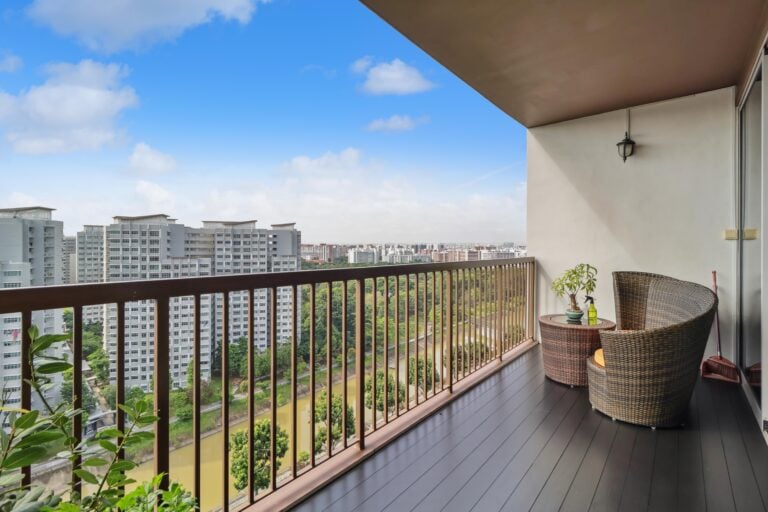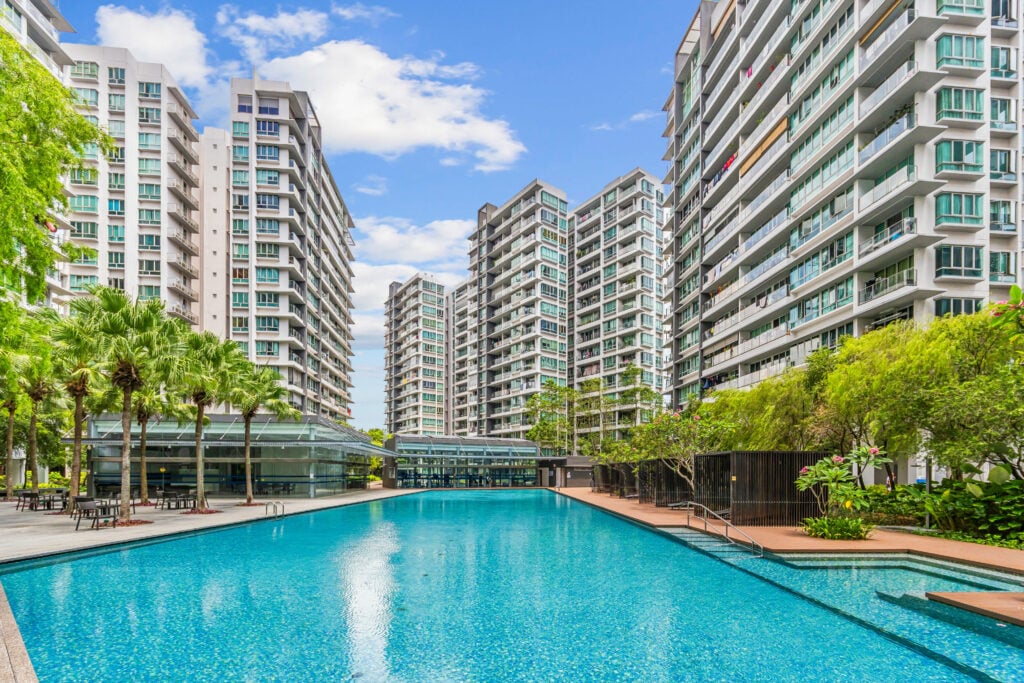
Deciding between an Executive Condominium (EC) and a private condominium is one of the biggest choices you’ll make as a homebuyer in Singapore.
An EC is a hybrid of public and private housing — built and sold by private developers with full condo facilities, but bought under HDB rules at a subsidised price for the first several years.
A private condo is fully private property from day one, open to anyone and free of minimum occupation periods or income limits.
Each path comes with its own trade-offs in eligibility, cost, grants, lock-in, and long-term flexibility.
This guide breaks down every factor so you can decide which fits your budget, timeline, and plans — including the major EC rule changes announced in May 2026.
1. Eligibility criteria
The first question is whether you can even buy an EC — many buyers can’t, and that settles the decision before price enters the picture.
ECs are reserved for Singaporean families with an income ceiling, while a condo is open to almost everyone. Here’s how the two compare:
| Eligibility factor | Executive Condominium (EC) | Private condominium |
| Citizenship | At least one Singapore citizen, forming an eligible family nucleus (e.g. with a spouse or family under the Public Scheme, or under the Fiancé/Fiancée Scheme) | Open to all — Singapore citizens, PRs, foreigners, and companies |
| Singles | Only eligible from age 35 under the Single Singapore Citizen Scheme; cannot buy a new EC under the family schemes | No family or marital requirement; singles can buy at any age (from 21) |
| Income ceiling (to purchase) | $16,000 gross monthly household income | No income ceiling |
| Property ownership | Must not own other property; any private property must be disposed of at least 30 months before applying | No restriction, but Additional Buyer’s Stamp Duty (ABSD) applies on second and subsequent properties |
In short, if your household earns more than $16,000 a month, you can’t buy a new EC — a condo is your only route into private property. If you do qualify for both, the rest of these factors will decide it.
2. Price & affordability
ECs are the cheaper way into a condo lifestyle. Because they’re launched at a subsidised price, ECs have historically cost around 20% to 30% less than comparable private condos in the same area at launch.
New-launch private condos now average somewhere around $2,200 per square foot — and considerably more in prime districts — while an EC lets a young family get the same pool, gym, and clubhouse for a meaningfully lower price.
That said, the EC discount has been shrinking. EC prices have appreciated strongly over the past decade, narrowing the gap, and well-located EC units have at times sold at prices close to nearby condos.
ECs also come with financing guardrails: a loan for an EC bought from a developer is capped by the Mortgage Servicing Ratio (MSR) at 30% of gross monthly income, whereas a condo loan is limited only by the broader Total Debt Servicing Ratio (TDSR).
Always compare actual recent transactions in the specific area you’re considering.
3. Grants & subsidies
This is a clear EC advantage a condo will never match. Eligible first-timer families can receive a CPF Housing Grant of up to $30,000 when buying a new EC directly from a developer, credited into the CPF Ordinary Account (Singapore Citizen–PR couples receive $10,000 less).
The grant lowers your effective price and the cash or CPF you need upfront.
A private condo comes with no grants or subsidies whatsoever — you pay full market price. For buyers who qualify, the EC grant plus the lower launch price is the single biggest financial reason to choose an EC over a condo.
4. Wait time
Most new ECs are sold before they’re built, so you’re buying into a construction timeline — typically around three to four years from launch to key collection. If you need a home quickly, that’s a real drawback.
A condo gives you both options. A new-launch condo carries a similar multi-year wait, but buying a resale condo means you can move in almost immediately — once the transaction is complete, you collect the keys and can renovate or move in.
If immediacy matters, a resale condo wins on timing; if you can wait, the EC’s savings may be worth it.
5. Minimum Occupation Period (MOP) & lock-in
This is the heart of the EC-versus-condo trade-off. An EC ties you down: you must physically occupy the unit through the Minimum Occupation Period and cannot sell it or rent out the whole flat during that time.
A condo has no MOP at all — you’re free to sell or rent from the day you collect the keys.
How long the EC lock-in lasts depends on when the project’s land was tendered — and that’s exactly what changed in May 2026, covered next.
The 2026 EC rule changes you must know
On 8 May 2026, the Ministry of National Development announced the most significant overhaul of the EC scheme in over a decade. The new rules apply only to new EC sites with a government land-sale tender closing on or after 8 May 2026.
Existing ECs and the five projects already in the pipeline (at Senja Close, Woodlands Drive 17, Sembawang Road, and Miltonia Close) keep the old rules.
So the ECs you can buy in the near term still follow the familiar 5-year MOP — the new rules matter most for ECs launching further down the road.
| Rule | Existing ECs (incl. 5 pipeline projects) | New EC sites (tender closing on/after 8 May 2026) |
| Minimum Occupation Period | 5 years | 10 years |
| Full privatisation | After 10 years | After 15 years |
| Deferred Payment Scheme (DPS) | Available | Removed |
| First-timer quota at launch | 70% | 90% |
| First-timer priority period | 1 month | 2 years |
For a first-time buyer, the higher 90% quota and the 2-year priority period are genuinely good news — they improve your odds of securing a unit at a popular launch and give you far more time to decide.
The longer 10-year MOP and the removal of the Deferred Payment Scheme are the trade-offs: future EC buyers are locked in longer and must plan their finances upfront rather than deferring the bulk of payment to completion.
6. Reselling & privatisation
An EC gradually “graduates” into private property. After the MOP, you may sell only to Singapore citizens or PRs; the unit is then fully privatised later (from the 11th year for existing ECs, or the 16th year for new sites), after which it can be sold to anyone, including foreigners — just like a normal condo.
Second-time buyers who purchase an EC from a developer also pay a resale levy, similar to second-timer BTO buyers.
A condo has none of this. There’s no minimum occupation period, no buyer restrictions, and no privatisation timeline to wait out — it’s private from day one and can be sold to any buyer at any time. If maximum flexibility is your priority, the condo is the cleaner option.
7. Renting out
With an EC, you cannot rent out the whole unit during the MOP — you must live in it — although you may rent out individual rooms while you stay there. Only after the MOP ends can you lease out the entire flat.
A condo can be rented out in full from day one, making it the obvious choice if rental income or an investment strategy is part of your plan.
8. Stamp duty (ABSD)
All buyers pay Buyer’s Stamp Duty, but Additional Buyer’s Stamp Duty (ABSD) is where the two differ in practice. New ECs are bought by Singaporean families, and a Singapore citizen pays no ABSD on a first property — so most EC buyers pay none. ABSD only bites if you’re buying an additional property.
For condos, ABSD scales up sharply for additional and non-citizen buyers: it applies on a citizen’s second and subsequent purchases, and foreigners pay a steep 60% (entities 65%).
This is also why foreigners effectively can’t use ECs as an entry point — they can only buy an EC once it has been fully privatised years later.
9. Facilities & living experience
Here the two are almost identical. ECs are designed and built by private developers, so they come with the same swimming pools, gyms, function rooms, BBQ pits, security, and landscaped grounds you’d expect in a private condominium.
On a day-to-day basis, living in an EC feels the same as living in a condo.
The main difference is that some condos — especially in prime, central locations — offer more extensive or premium facilities and finishes. But for the core condo lifestyle, an EC delivers essentially the same experience at a lower price.
10. Size & layout
ECs tend to offer practical, family-sized layouts and are often seen as good value per square foot, which is part of their appeal to upgraders. Unit mixes are geared toward families, with a healthy supply of three- and four-bedroom configurations.
Condos span a much wider range — from compact one-bedroom and studio units aimed at singles and investors, to large luxury apartments and penthouses. If you want a very small unit or a high-end, spacious layout in a central location, the condo market simply offers more variety.
11. Location options
ECs are built where the government releases EC land, which is typically in the suburban, non-central regions of Singapore (Outside Central Region). You won’t find a new EC in the city centre.
For many families that’s perfectly fine — these estates are often near schools and amenities — but your choice of location is limited to wherever EC sites are launched.
Condos are available island-wide, including the city fringe and prime central districts. If you have your heart set on a specific or central location — or want a freehold property, which ECs never are — a condo gives you far more choice.
12. Resale value & capital appreciation
ECs have a strong track record of capital appreciation. Because you buy below market and the unit becomes a full private condo after privatisation, many EC owners have made healthy gains once the MOP is cleared — the “buy subsidised, sell private” upside is the core investment case for an EC.
A condo’s value is driven purely by the market, location, and tenure, with no built-in discount-to-private upside. A well-chosen condo in a sought-after area can certainly appreciate, but it doesn’t enjoy the structural head start an EC gets from its subsidised launch price.
Note, too, that the new 10-year MOP on future ECs pushes any resale further out, which favours genuine long-term owners over those hoping for a quicker exit.
Does buying a condo cost more than an EC?
Yes — for buyers who qualify for both, a condo almost always costs more overall. An EC launches at a lower price, comes with up to $30,000 in grants, and sits in a value-focused segment, while a condo is bought at full market price with no subsidies.
What you pay the condo premium for is freedom and choice: no income ceiling, no occupation period, the ability to sell or rent immediately, access to central and freehold locations, and a far wider range of unit sizes. You’re trading dollars for flexibility.
Should you choose EC or condo?
There’s no single right answer in the EC vs condo debate — it comes down to what matters most to you, and whether you qualify in the first place:
- Want the best value and you qualify? Choose an EC — lower price plus grants make it the most cost-effective route into a condo lifestyle.
- Earn above $16,000 a month, or aren’t a citizen family? A condo is your only option for private property.
- Need flexibility to sell or rent anytime? A condo has no MOP and no privatisation wait.
- Set on a central or freehold location? Condos offer far more choice; ECs are suburban and leasehold.
- Buying to live in long-term and happy to wait? An EC’s subsidised price and appreciation potential are hard to beat — just budget for the longer 10-year MOP on new projects.
If you qualify and want to maximise value, an EC is hard to beat. If you value flexibility, location, and choice, a condo earns its premium.
Still weighing your options?
A Propseller agent can run the numbers for your specific situation — from eligibility and grant amounts to loan affordability and the best projects for your budget — and guide you through every step.
Get in touch with a Propseller agent today to find the home that’s right for you.