Once you’ve decided to sell your property, the next important step is determining whether to sign an exclusive agreement with one agent/one agency or to engage multiple agents.
For many homeowners, there’s a prevailing belief that involving multiple agents to market their home will bring better results. They often think, “Since there are so many agents available and eager to take up my listing, why shouldn’t I cast a wider net? More agents surely mean more exposure, and more exposure should naturally translate to more offers, right?”
It seems logical. Many sellers approach this as a numbers game: the more agents you have, the better your chances. But is that truly the case?
Unfortunately, what might initially seem beneficial actually poses significant risks.
What is an Exclusive Agency Agreement?
Before we get into the risks, let’s take a moment to clarify what an exclusive agency agreement actually involves.
An exclusive agency agreement is an agreement between a property owner, a property agent, and a property agency, under which only one agent and one agency are appointed to market and handle the sale, purchase, or lease of a property for a specified validity period—typically three months.
During this period, you may still choose to complete the transaction on your own or through another agent or agency. Still, you remain liable to pay commission to the appointed agency, whether such a buyer is introduced by the agency or not.
Even if the transaction concludes after the validity period, you may still owe commission if the buyer was introduced during the validity period and the transaction is sold within three months after the agreement ends.
As a property seller, this agreement gives you peace of mind: your appointed agent and agency have every reason to put in maximum effort and invest in marketing dollars, knowing their work, if done well, is going to be rewarded.
The Risks of Working with Multiple Agents
1. No One Is Truly Representing You
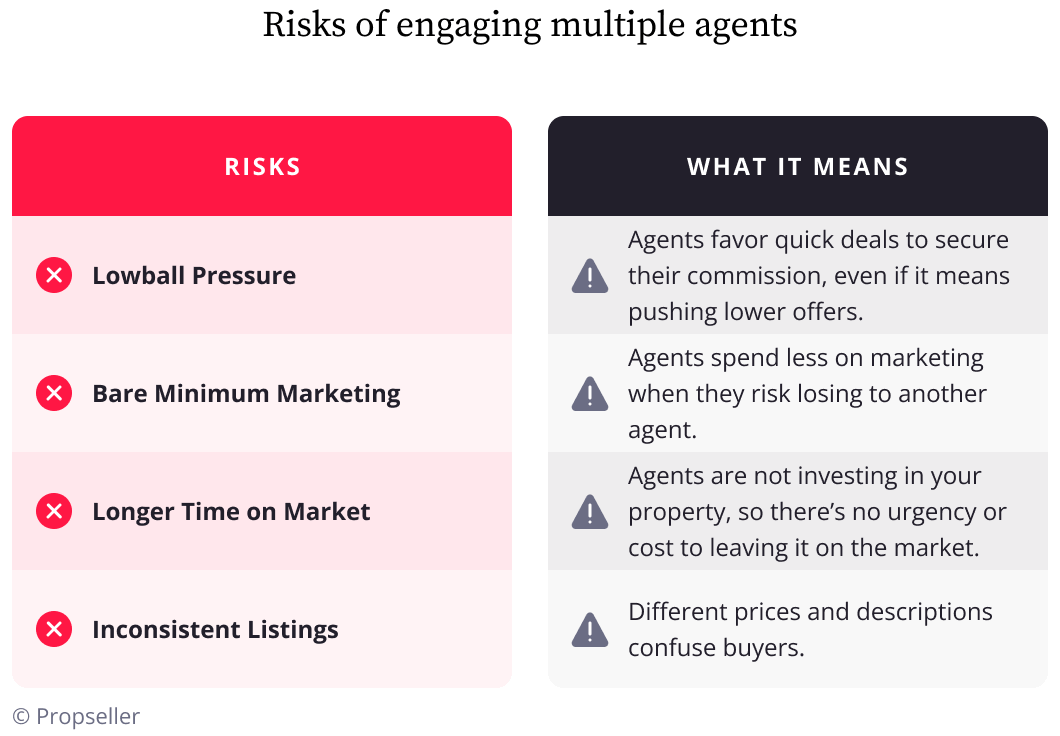
When you work with multiple agents under an open listing, no single agent is truly representing you. With low chance to get a commission, agents operate transactionally: their priority is not to protect your best interests, but to secure a quick deal before someone else does.
In this setup, agents are incentivised to match buyers with a property, not necessarily your property, and to prioritise deals they can close fast. That means they’re less likely to hold out for the best possible price or to negotiate assertively on your behalf, because every day they wait increases the risk that another agent will close the sale and take the commission.
Instead of working as your advocate, they work for the transaction. This can lead to subtle pressure to accept the first “good enough” offer, even if waiting might bring in more. You might hear comments like, “The buyer might walk if you don’t lower your price,” or “Your neighbour sold for less, so you should too.” These tactics are designed to close a deal quickly, but they can result in you walking away with less than your property’s true market value.
2. Little to No Marketing Is Done for Your Property
In today’s property market, exposure isn’t driven by the number of agents you have, but by the reach and quality of your marketing. That means the number of impressions, views, and targeted buyer interactions your listing gets.
High-quality exposure comes from budget and effort: professional photography, engaging copy, premium portal placements, targeted online ads, and ongoing campaign optimisation.
Under an open listing, agents are unlikely to commit those resources without a guarantee they’ll be the one to close the sale: if another agent finds a buyer first, all that investment is lost with no return.
Instead, they tend to post a basic listing and wait to see if it gets quick traction. If the property doesn’t generate easy enquiries early on, they’re likely to drop their focus and move on to other listings that are easier to close.
The result? Your property gets only minimal marketing push, leading to fewer buyer enquiries, fewer viewings, and ultimately fewer offers.
3. Your Home Stays on the Market Too Long
With multiple agents involved, nobody really feels responsible for selling your property within a specific timeframe. Because agents typically aren’t investing much in marketing your home, there’s no real urgency or cost to leaving it on the market for longer periods. This means agents often adopt a laid-back attitude, without any clear plan or regular follow-ups.
For example, an agent might occasionally arrange a viewing but not actively follow up with interested buyers or gather helpful feedback. Sometimes, especially newer agents, might even use your home as a chance to practice their viewing and selling skills. So, you might see plenty of viewings happening, but very few actual offers coming through.
The longer your home sits on the market, the more potential buyers start to wonder why it hasn’t sold yet. They’ll assume there’s something wrong with it, which makes them hesitant to offer good prices. In the end, the prolonged listing period can significantly reduce your home’s appeal and weaken your position when negotiating offers.
4. Buyers Start To Think Something’s Wrong With Your Property
When you engage multiple agents, your property might appear multiple times across the same property portal. Each listing could show different descriptions; for instance, one agent might emphasise that your home is conveniently located next to a bustling mall, while another might say it’s a quiet, peaceful area. These conflicting messages can easily confuse potential buyers.
Additionally, agents might set different prices based on their strategies or individual conversations with you. Seeing multiple listings for the same property gives buyers the idea that you’re desperate to sell quickly. Buyers might start to wonder if there’s something wrong with your property, such as hidden defects or other issues.
This confusion can make buyers cautious and encourage them to not enquire at all or to bargain harder. Some buyers may even approach different agents separately to negotiate the price downward, creating competition that ultimately harms your chances of getting a fair offer. This situation slows down the sale and makes it difficult to achieve your desired price.
The Benefits of Working With an Exclusive Agent
Once you understand the risks of working with multiple agents, the advantages of exclusivity become even clearer. Choosing to work with a single, committed agent and agency is a smarter strategy that ultimately leads to better results, assuming you pick the right one.
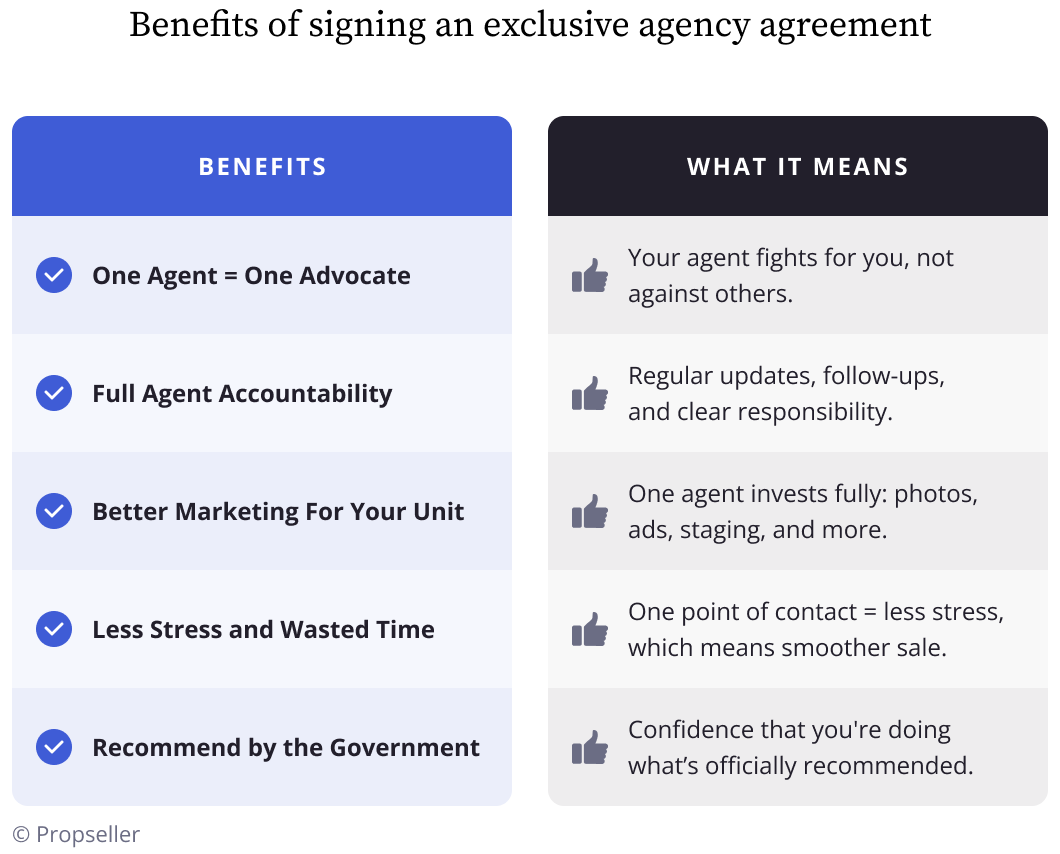
1. One Agent Fully Aligned With Your Goals
With an exclusive agreement, your agent’s success is tied directly to yours. They have every reason to focus on your priorities: securing the best price, managing the process smoothly, and protecting your interests from start to finish.
You get one dedicated professional who is fully aligned with your goals, serving as your single point of contact. They’ll coordinate every step, with complete clarity and consistency, so you never get mixed messages or conflicting advice from multiple agents.
2. Total Accountability From One Agent
When you give a job to many people, no one feels fully responsible. But when one agent is exclusively in charge, accountability skyrockets. Your agent is now personally responsible for delivering results, and they know it.
This means regular updates, prompt follow-ups with buyers, strategic feedback, and a clear plan of action. If something isn’t working, your agent will proactively pivot, not disappear.
3. Exclusivity Means Better Marketing For Your Property
When you sign an exclusive agreement, your agent and agency know that any investment they make in marketing your property is worthwhile because they’re the only ones representing you. They’re no longer worried about someone else stealing the deal.
This allows them to go all-in on your listing: professional photos, virtual tours, digital ads, premium portal placements, and even staging consultations if needed. Hence, they create maximum visibility for your property across all channels, with a consistent message that builds real buyer interest.
Rather than a half-hearted marketing push, you get a full-scale campaign designed to attract qualified buyers and better offers.
4. A Smoother, Less Stressful Experience
Selling a home is already a big decision, so why make it more complicated than it needs to be? With multiple agents involved, you’ll find yourself repeating the same information, coordinating viewings across different schedules, and fielding mixed advice on pricing and strategy.
With one dedicated agent and agency, everything is streamlined. You get a single source of truth, a clear process, and a partner who’s there to guide you from start to finish. You spend less time managing the sale and more time focusing on what comes next.
5. Exclusive Agreements Are Officially Recommended by the CEA
The Council for Estate Agencies (CEA), a statutory board under Singapore’s Ministry of National Development, strongly recommends exclusive agency agreements as part of its Commitment to Service initiative.
According to the CEA, exclusive agreements clearly define an agent’s responsibilities and foster higher levels of accountability, leading to better overall service quality. By entering into an exclusive arrangement, agents can fully dedicate their time, resources, and expertise to your property project, significantly improving the chances of achieving optimal results. The CEA’s advocacy for exclusive agreements reflects its commitment to elevating professional standards and ensuring consumers receive superior service and outcomes in the property market. Read more here.
At Propseller, we follow this best practice because we know it works. Our Real Estate Consultants are trained to deliver results. We hold ourselves to high standards, and our clients benefit from that discipline every day.
So, what kind of sale do you want? Five agents doing the bare minimum? Or one expert doing the absolute most?